
Beyond the "Like" Button: 5 Radical Shifts for a High-Performance Critique Culture
Sharing unfinished work is more than just a moment of personal vulnerability; it is the primary psychological barrier that holds teams back from true innovation. As a design leader, I’ve seen how the discomfort of the "blank canvas" can cause designers to polish in isolation for too long, hiding the very flaws that a collaborative eye could solve in minutes. To move from average solutions to exceptional products, we must embrace this tension as a normal, productive emotion.
To build a mature culture, we must first distinguish a Design Critique from a Design Review. According to the Nielsen Norman Group (NN/G), a review is an evaluative gate. Often held at the end of a project, to ensure heuristic compliance and gain final approval. A critique, however, is a standalone session held during the creative process. Its purpose is improvement, not approval. It is a collaborative tool for excellence, not a judgment of talent.
1. Critique is a Skill, Not a Personality Trait
A harmonious feedback culture isn't a happy accident of "nice" people; it is a learnable, professional skill. Productive sessions require a "harness" to keep the team moving in the same direction.
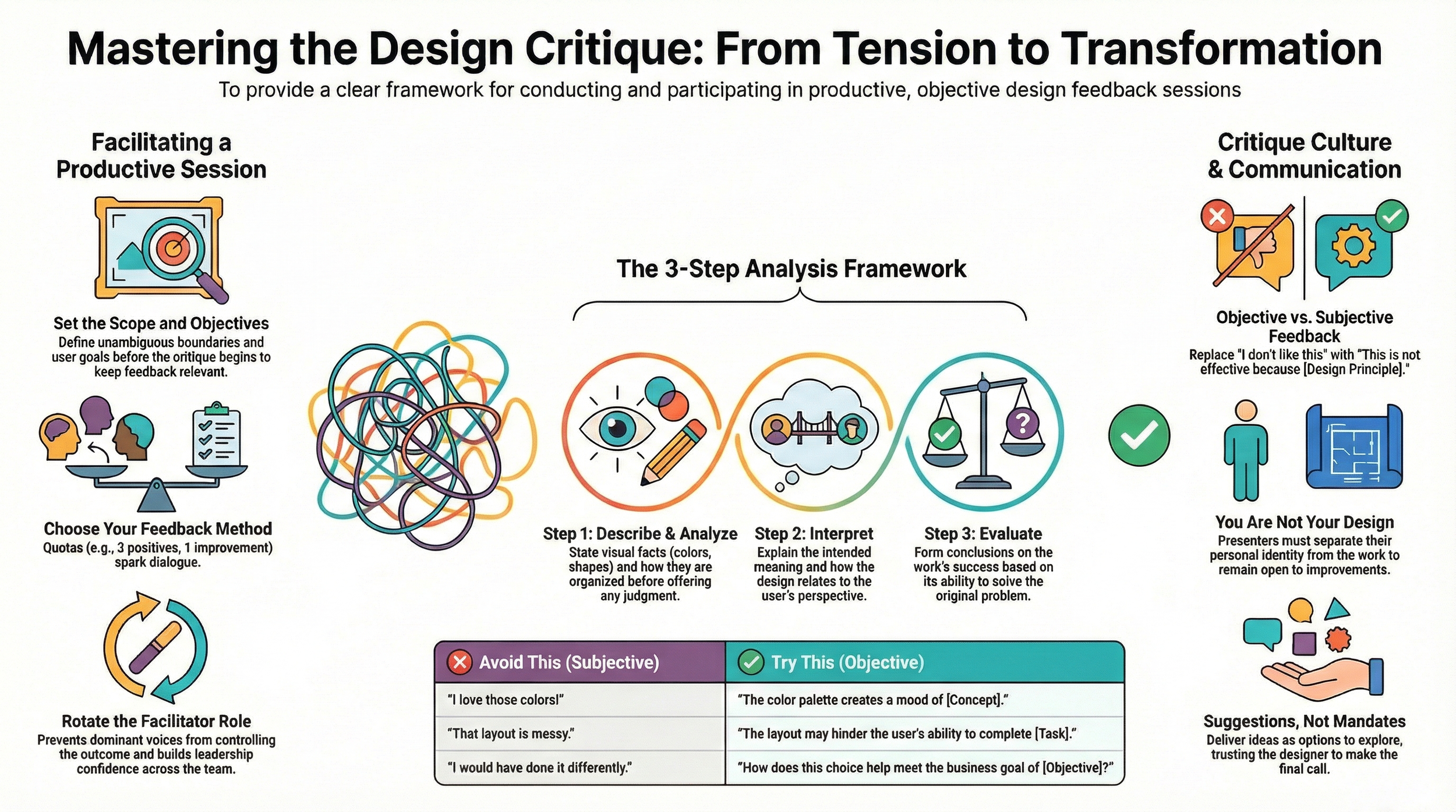
The most effective tool for this is the Facilitator. This role involves the "conscious, balanced management of conversations," ensuring the group remains focused on design objectives rather than personal opinions. In a high-maturity environment, you should rotate the facilitator role from session to session. This prevents any single voice from dominating the team’s creative direction and provides a safe space for introverted members to gain confidence in managing high-stakes discussions.
To democratize the room, use structured methods:
• Round Robin: Every participant shares their perspective one by one. This ensures every voice is heard before anyone is allowed to respond, preventing "groupthink."
• Quotas: To initiate the exchange, the facilitator gathers a specific number of comments from each person (e.g., "Give me two elements that meet the objective and one that could be improved").
The Radical Shift: Moving from "informal hallway chats" to these structured sessions removes the "target range" mentality. When work is shared without a framework, designers often feel their work is being "blown out of the sky" by a thousand uncoordinated complaints. Structure provides the safety necessary for true honesty.
2. Critique the Work, Not the Human
A foundational pillar of professional design is the understanding that critique serves the work, not the person who made it. When feedback feels like an attack, the creative process stalls.
The bridge between feeling and analysis is objective vocabulary. We must move away from subjective "I like/don't like" comments. Instead, adopt specific linguistic tools. I encourage teams to use the following sentence starter: “I think this is effective/not effective because [insert design vocabulary].” This forces the critiquer to tie their feedback to the project's goals.
"Critique is one of the most valuable components of a formal art and design education... A critique of your work is not a critique of your humanity, and making bad work does not make you a bad person." — The Purpose of Critique
The Radical Shift: "Harsh" or "brutal" critiques are actually just ineffective and belittling. If a designer leaves a session feeling "beaten up," the critique has failed its primary objective: empowering the creator to iterate. A "tough" critique should leave a designer feeling focused and energized, not defeated.
3. The "Describe-Analyze-Interpret-Evaluate" Framework
To prevent the common pitfall of stakeholders rushing to judgment, we can adopt a structured four-step anatomy derived from art criticism. This sequence ensures feedback remains analytical and grounded in visual facts before moving to opinion.
• Describe: State the visual facts without value words like "beautiful" or "busy." Focus on the "Pillars" of design: Line, Shape, Form, and Subject Matter. (e.g., "There is a primary red button in the bottom right corner.")
• Analyze: Identify the design principles at play. Look at Balance, Proportion, Hierarchy, Rhythm, and Harmony. How are the elements fitting together to create the composition?
• Interpret: Explain the perceived intent. What does the work make you think or feel? What is the "socially constructed reality" or meaning behind these specific decisions?
• Evaluate: Form conclusions on success based on the previous three steps. Does the work fulfill its intended purpose and benefit the user?
The Radical Shift: This framework prevents the most common UX pitfall: stakeholders saying "I don't like that color" (Evaluation) before they even understand the user flow (Description). By mandating a "Description" phase first, you ensure everyone is looking at the same reality before they judge it.
4. The Power of "Problems First, Solutions Second"
In the heat of a meeting, participants often feel the urge to "design on the spot." This is a trap. When we propose new ideas immediately, we end up arguing over solutions without agreeing on the underlying problem.
Adopt the GV guideline: Identify the problem first. If someone has a suggestion, they must first articulate the current design flaw that their idea is meant to solve. Furthermore, all feedback should be framed as "suggestions, not mandates." The designer is the owner of the work and must be trusted to explore the direction on their own.
The Radical Shift: We must recognize that abstract ideas always sound better than concrete ones. A verbal suggestion in a meeting sounds perfect because its constraints are invisible. The concrete design on the screen is "messy" because it accounts for technical requirements and edge cases. To ground the room, simulate the customer experience by flipping through screens like a user would, rather than pitching a static mockup. This forces the group to see the constraints and prevents "solving" in a vacuum.
5. Design is Everyone’s Job
"Tunnel vision" is the silent killer of great products. When designers only talk to designers, they lose the context of the broader business and technical reality. High-performing teams invite cross-disciplinary members, Sales, Engineering, and Customer Support into the critique.
Each discipline brings a different "socially constructed reality" to the table. A developer's perspective on technical feasibility is the necessary antidote to a designer’s idealistic vacuum. Including diverse voices ensures the design is grounded in business goals and customer pain points.
"The best designs spring from collaborations between product, engineering, customer support, sales, and others. Simply put: Design is everyone’s job." GV Guide to Design Critique
The Radical Shift: Early buy-in prevents "throwing time and money away" later. When a developer questions technical feasibility while a design is still a draft, it saves weeks of wasted effort. Critique is the mechanism that builds team consensus and trust before the first line of code is ever written.
Conclusion: Building the Muscle of Honest Feedback
A healthy critique culture transforms the feedback loop from a source of anxiety into a strategic advantage. It builds the team trust necessary to take risks and creates a shared vocabulary that elevates every product decision.
If your organization is struggling with "polite silence" or "brutal" feedback, the best philosophy is to "start soon and start small." Don’t wait for a new project kickoff. Dedicate 30 minutes this week to a round-robin session on a current draft.
Final Thought: Does your team feel "safe" enough to share work that is only 20% finished? The mark of a mature creative culture is when the designer’s ego no longer serves their own pride, but serves the user’s needs instead. Be the leader who makes that shift possible.
